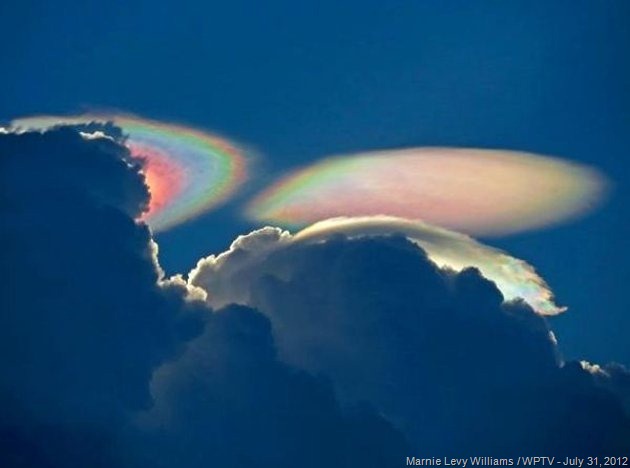
Evergreen science + local-interest refresh. On July 31, 2012, South Floridians shared photos of glowing, dome-like colors in the clouds and nicknamed them “fire rainbows.” The nickname stuck in local conversation — even when the physics is a little more specific than the nickname.
What people usually mean by “fire rainbow”
Two different sky shows get mixed together in casual talk:
- Cloud iridescence: pastel, mother-of-pearl colors in clouds, often near the sun, caused by similarly sized water droplets or ice crystals diffracting light. NASA and weather educators often point to iridescent clouds for photos like the 2012 South Florida set.
- Circumhorizontal arc: the rarer “true” fire rainbow look — a colorful band parallel to the horizon — which needs high ice-crystal clouds and a sun high in the sky. That geometry is less common in some seasons/latitudes than simple iridescence.
Either way, the wow factor is real: bright colors that look painted onto storm or haze tops.
Why South Florida sees wild cloud color
Summer storm towers grow fast here. When moist air is shoved upward and thin cloud sheets form with relatively uniform droplets, you can get brief iridescent patches — especially if you are viewing from the right angle relative to the sun. Colors shift as you move, so two neighbors can swear they saw different hues.
How to look safely
- Never stare at the sun. Use buildings or a hat brim to block the solar disk while you glance at nearby cloud edges.
- Phone cameras often exaggerate saturation — still fun, still share.
- If lightning is close, admire from indoors. No photo is worth a storm-chase mistake.
Seen something wild overhead lately? Tell us in the comments or email ILoveSouthFlorida@gmail.com. For more outdoor sky-watching, see our refreshed Perseid meteor shower guide.
Nickname retained for search familiarity; descriptions align with common meteorology/NASA explanations of iridescent clouds and related optical phenomena.